
Signs your company has outgrown "whoever has time" marketing
Key takeaways
A website, sales deck, and LinkedIn page that look like different companies are usually the first visible sign.
Marketing that rises and falls with how busy the BD lead is shows there's no plan behind it.
Vendors who've never heard of each other means nobody is coordinating them.
If two or more of these sound familiar, your company has likely outgrown handling marketing as a side task.
When was the last time someone at your company planned marketing more than a month out?
If you had to think about it, you're not alone.
Here are the signs I look for when a company has outgrown "whoever has time" marketing.
What's the first sign you've outgrown "whoever has time" marketing?
Your assets don't match.
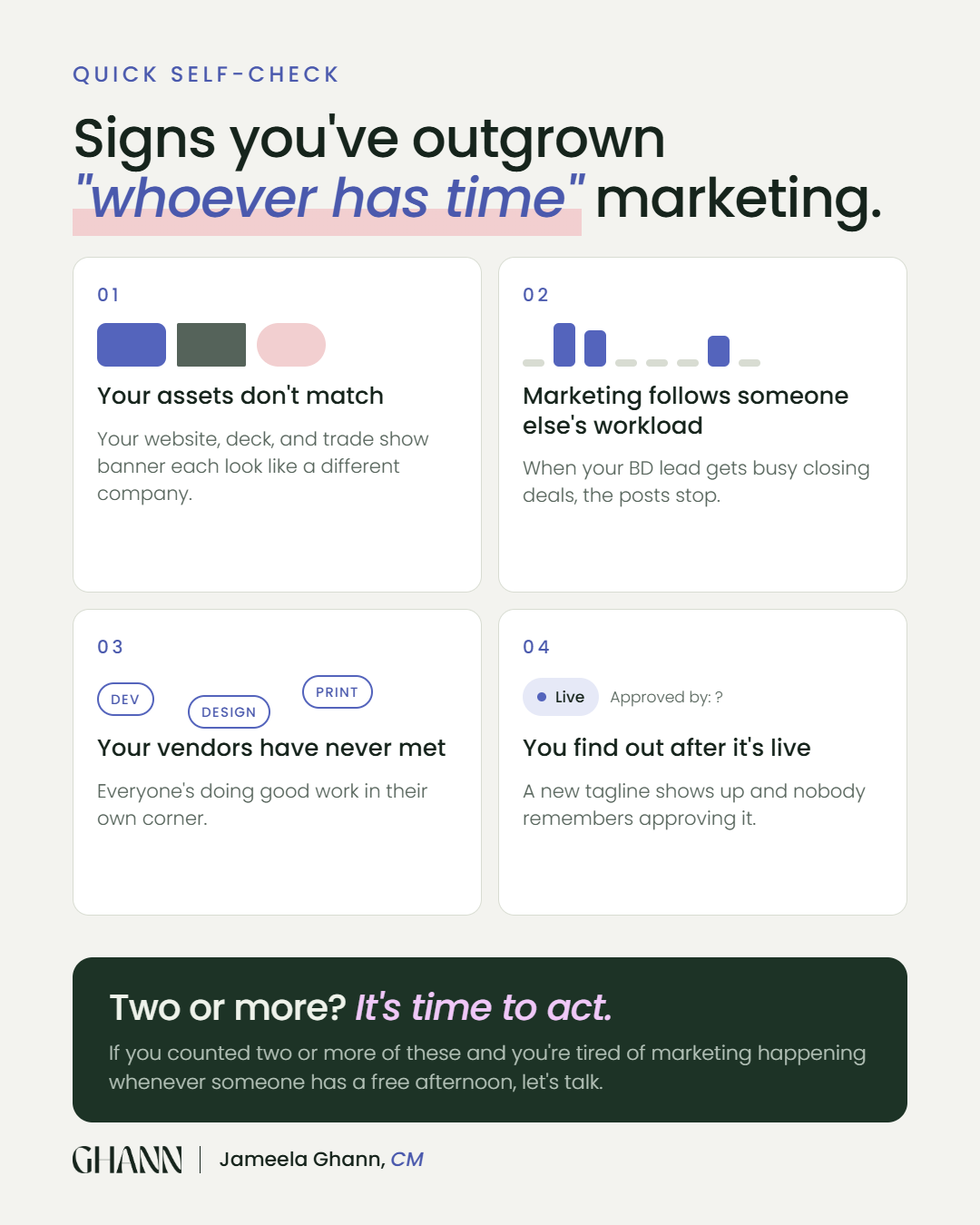
Your website, sales deck, LinkedIn page, and trade show banner each look like they belong to a different company.
This is usually the one people notice first, sometimes because a prospect or a new hire points it out.
What's a less obvious sign?
Your marketing rises and falls with someone else's workload. When your BD lead has a slow month, you get a burst of LinkedIn posts. When they're busy closing deals, marketing disappears.
What does it look like with your vendors?
Your vendors have never heard of each other.
Your web developer has no idea what the event supplier is building for your next conference, and your designer has never seen your latest sales deck.
Everyone's doing good work in their own corner.
What's the sign leadership usually feels?
You find out about marketing decisions after they're live. A new tagline shows up on the website, or the logo looks a little different on the new brochure, and nobody can remember who approved it.
How many of these signs mean it's time to act?
Two or more. Once your assets stop matching, whoever picks up the next project has no clear standard to follow, so every new piece drifts a little further.
FAQ
What if we only have one of these signs?
Then it might just take a conversation with whoever's handling marketing right now. Two or more usually means nobody has marketing as their main job, and a quick chat won't fix that.
Do these signs mean we need a marketing department?
Not necessarily. A lot of companies at this stage start with a fractional partner like me, who owns the plan and the vendors part time.
Who usually notices these signs first?
Usually leadership, after a specific moment. Maybe a trade show didn't go well, or a prospect mentioned that your website and your proposal didn't match.
If you counted two or more of these and you're tired of marketing happening whenever someone has a free afternoon, let's talk. I'll help you figure out what to fix first. Book a call.

