
Your LinkedIn Isn't Working Because Your Offer Sounds Like Everyone Else's
If LinkedIn feels like a slot machine it's probably because your offer is generic.
Some weeks, you get a few comments and DMs. Other weeks it's crickets. Someone says "Let's chat" and then ghosts you. A referral shows up out of nowhere and saves the month. Then it goes dry again.
What I’ve found is that most boutique professional service firms don't have a LinkedIn problem.
They really have an offer clarity and qualification problem.
Because when your offer is generic, you’ll get generic leads. You know the ones:
Price shoppers
"Can you send info?" people
Folks who are nowhere near ready
Prospects who need a totally different kind of help
Wrong size, wrong budget, wrong urgency
And then your follow-up gets messy because you're trying to rescue bad-fit conversations with more effort.
So when the wrong leads show up, they don't just waste time. They ruin your week.
This post is about positioning that repels bad-fit leads and pulls the right ones in. By the end of this post, you'll understand how to reshape your LinkedIn strategy to draw in qualified leads effectively and consistently.
The real reason you're attracting the wrong leads
Your offer probably sounds like one of these:
"We help businesses grow."
"We do strategy and execution."
"We help leaders scale."
"We offer consulting, coaching, and training."
"We help people improve their mental health."
"We help businesses with legal support."
None of that is wrong. It's just not differentiating.
If your prospect can swap your firm name with five competitors and the sentence still works? Your positioning isn't positioning. It's a label.
And labels attract everyone.
What "sounds like everyone else" actually means
Most offers are written as: Service category + outcome
Example: "We help clinics get more patients."
That tells me what you do. It doesn't tell me why you're the right choice, who you're best for, or what needs to be true for this to work.
So the market fills in the blanks with assumptions. And those assumptions bring you the wrong leads.
Like the "more patients" person who thinks you mean ads, but you actually mean systems. Or the "legal help" person who needs cheap templates, but you do high-touch advisory. Or the "coaching" person who wants motivation, but you run an implementation sprint.
Your offer isn't filtering, so you're filtering manually in DMs and calls.
That's why you feel busy and still inconsistent.
The fix: Position around your vehicle, not your category.
Your value is not “legal help.”
Your value is not “financial services.”
Your value is a method that takes someone from Point A to Point B in a predictable way.
That method is your vehicle.
When you position around the vehicle, three things happen:
You sound specific, which increases trust
People self-select faster, which reduces tire-kicking
Your content gets easier to write, because it’s anchored to a system)
What vehicle-first positioning looks like
Instead of: "I help professional service firms get leads on LinkedIn."
You lead with the method: "We install a LinkedIn-to-booked-call system that turns interest into qualified booked calls, without hiring a full-time marketer."
Now your offer has a shape. It implies there's a build, a sequence, a definition of "qualified," and a repeatable outcome.
That's what buyers want. They want the mechanism, not the vibes.
This is also why "Beyond Referrals LinkedIn Engine" works as a name. It points to the real promise: predictable growth without waiting for referrals.
The 3 parts of positioning that stop wrong leads

You don't need a clever tagline. You need three practical pieces that do heavy lifting.
1. An offer spine that makes your method obvious
What is an offer spine?
An offer spine is the core sentence your entire funnel is built on.
You can use this structure to create yours:
For [WHO], we [INSTALL / BUILD] [VEHICLE] so you get [RESULT], without [COMMON PAIN], in [TIMEFRAME].
Example:
For boutique professional service teams, we install a LinkedIn-to-booked-call system so you turn LinkedIn interest into qualified booked calls, without hiring a full-time marketer, in 8 weeks.
That sentence contains:
The buyer (not everyone)
The method (install a system)
The outcome (qualified booked calls)
The constraint (no full-time marketer)
The timeframe (8 weeks)
That's positioning.
2. Qualification rules that you say out loud
Most firms keep qualification in their head. Then they act surprised when random people show up.
Put the rules in the offer. Not in a rude way, of course, but in a "this works best when..." way.
Examples of qualification rules that repel wrong leads:
"You need someone on the team who can implement (marketing coordinator, comms, admin, intake)."
"You need a website you can update (or a developer who can turn changes around in 48 hours)."
"This is not 'we do it for you.' This is a system install."
"If the owner won't sponsor decisions, implementation stalls."
This isn't "negative copy." This is honesty.
It's also what makes the right buyer feel relieved, because they know you're not going to waste their time.
3. A clear conversion path that matches the engagement value
If you sell $10k, $15k, $25k engagements, you can't treat the conversion path like a low-ticket product.
A clean path looks like:
Post → landing page → application → invited to book a call
That sequence does two important things:
1. It filters for fit before your calendar gets involved
2. It creates a "yes, I'm serious" micro-commitment (application) that reduces ghosting
If your LinkedIn is getting attention but not booked calls, this is usually the missing piece. Not "more posting."
Quick self-audit: Are you attracting wrong leads because of positioning?
Read your current offer and answer these three questions.
The "swap test"
Could five competitors copy-paste your sentence and it still makes sense? If yes, you're not positioned uniquely.
The "how" test
Does your offer explain how you get the outcome, even at a high level? If not, your prospect assumes it's the same as every other option (and treats you like a commodity).
The "fit test"
Does your offer say who it's for and who it's not for?
Concrete examples: Generic offer vs vehicle-first offer
Here are a few rewrites that show what "vehicle" does.
Boutique law firm (business immigration, employment, corporate)
Generic: “We provide legal services for growing businesses.”
Vehicle-first: “We run a 3-step legal readiness sprint for growing employers: risk review, contract and policy cleanup, then an ongoing retainer structure so legal stops being an emergency.”: "We provide legal services for growing businesses."
Vehicle-first: "We run a 3-step legal readiness sprint for growing employers which includes an audit risk, contracts and policies, and set an ongoing retainer structure so legal stops being an emergency."
Advisory or consulting firm
Generic: “We help companies grow with strategy.”
Vehicle-first: “We build a conversion system that turns content into qualified calls using a clear path, follow-up workflows, and a weekly scorecard, so you stop relying on referrals to hit your number.”
This is basically the logic behind the LinkedIn Engine offer.
How to translate vehicle-first positioning onto LinkedIn

You don't need to rewrite your whole brand in one day.
Start with these four surfaces:
1. Your headline
Stop listing roles. Lead with who you help and the system you install.
Template: I help [WHO] get [OUTCOME] by installing [VEHICLE].
2. Your About section
Your About should answer, in order:
What you do (vehicle)
Who it's for
The problem it fixes
The path to contact you
The requirements (so you repel bad-fit leads)
3. Your posts
Most content fails because it stays at the "tips" level.
Your best content angles come from your system build:
Positioning and offer angles (why most offers attract the wrong people)
The conversion path (post to page to application to call)
Lead handling rules (no lead disappears)
Follow-up sequences (reduce ghosting, reduce no-shows)
Tracking (what "working" actually means)
4. Your CTA
High-ticket CTAs shouldn't be "let me know."
It should be one clear next step that protects your calendar.
Example: "Apply first. If it's a fit, you'll be invited to book a call."
That's clean. It's confident. It filters.
If your follow-up is messy, your positioning needs to do more filtering
When your positioning is vague:
You get too many different kinds of inquiries
Each inquiry needs custom handling
You can't standardize follow-up
Leads slip through the cracks
You blame consistency, but the real issue is randomness upstream
When your positioning is tight:
Leads arrive pre-qualified
Your team can route them consistently
Your follow-up can be templated
You can measure what's actually converting into booked calls
That's why your offer matters. It sets expectations and protects delivery.
(Also, it attracts the kind of buyer who wants implementation, not entertainment.)
The simplest rewrite you can do today
If you do nothing else, rewrite your offer into this:
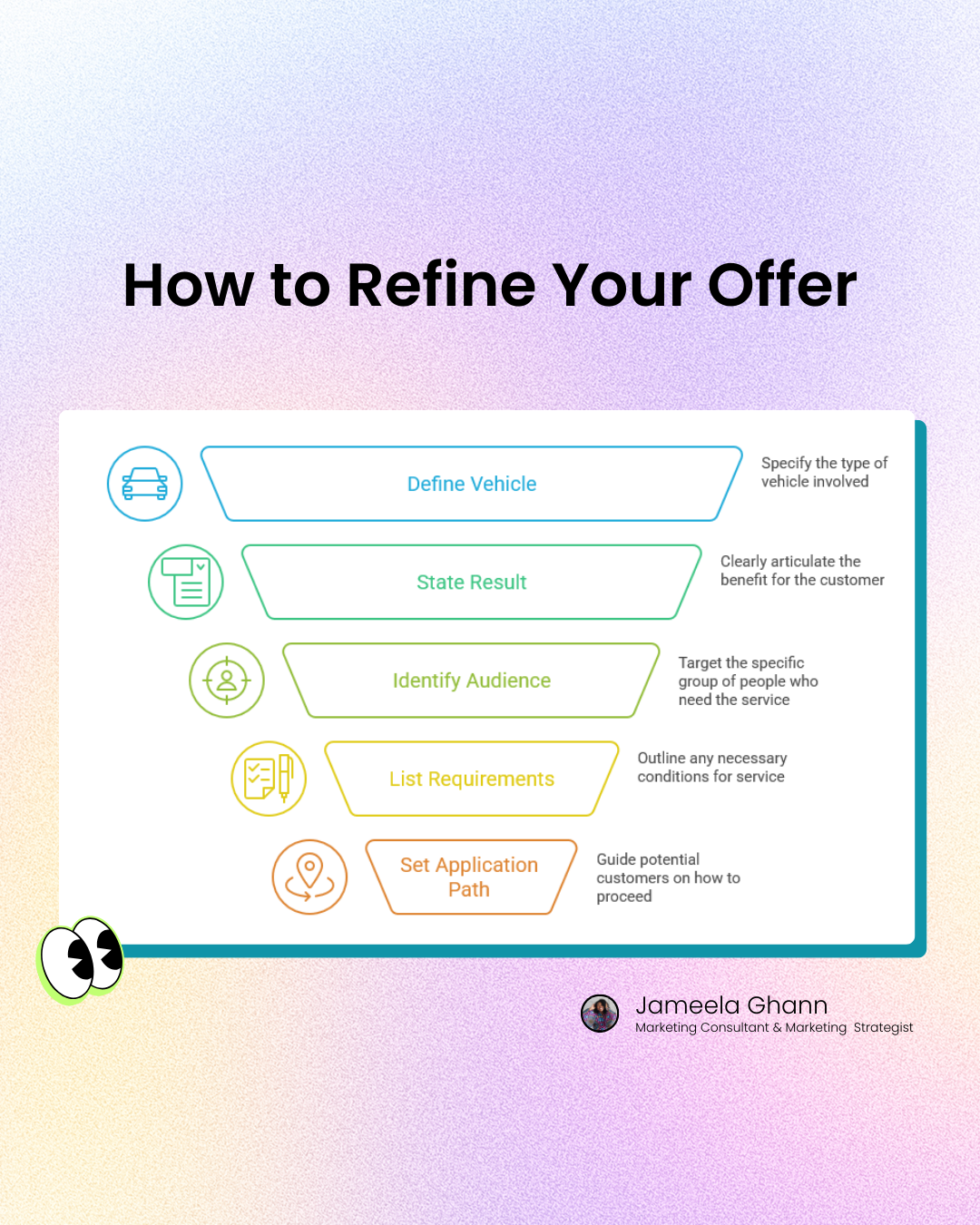
We install [VEHICLE]. So you get [RESULT]. It's for [WHO]. It requires [REQUIREMENTS]. The path is [APPLY FIRST].
That's enough to stop a lot of wrong leads immediately.
Want to turn your LinkedIn into a lead-engine?
If you want to stop saying "I should fix LinkedIn" and turn it into a real channel, you need the system behind it:
Clear positioning and offer angles
Landing page and application-first funnel
LinkedIn organic system (cadence and templates that drive action)
Tracking and a weekly dashboard tied to booked calls
Lead handling rules (CRM optional)
Follow-up sequences that increase booked calls
LinkedIn ads setup playbook that supports the exact funnel
A replication plan to reuse the same system across other channels
That's the Beyond Referrals LinkedIn Engine.
It's not a content course. It's a system. It's designed for professional service teams that want predictable growth without hiring a full-time marketer.
If it's a fit, you apply first, then you're invited to book a call.
Apply Now
Further resources (if you want to go deeper)
If you want predictable leads beyond referrals:
Referrals Aren’t a Growth Plan: Here’s What a Real Lead Engine Looks LikeIf you want your LinkedIn to attract the right people (not everyone):
Your LinkedIn Isn't Working Because Your Offer Sounds Like Everyone Else'sIf you want to stop “nice chats” and start getting qualified calls:
Stop Booking The Wrong Calls by Implementing an Application-First FunnelIf you want your website to do the pre-qualifying for you:
Does Your Website Match Your Caliber? A Guide to Pre-Qualifying High-Ticket Clients Without Feeling SalesyWant a quick check on what’s breaking in your system right now?

