
LinkedIn Organic Content Strategy That Actually Drives Leads and Booked Calls for B2B Companies
Sarah runs a strategy consulting firm in Toronto. She's been posting on LinkedIn for eight months. Her content gets decent engagement: 20-30 likes, a few comments.
But her phone isn't ringing.
Last week, she posted about supply chain optimization. Thirty-seven likes, five comments. Zero inquiries.
Meanwhile, her competitor posted once about a client case study and booked two discovery calls that same week.
What's the difference? Sarah's creating "engagement content." Her competitor is creating "lead content."
And yes, there's a big difference.
Why Most B2B LinkedIn Content Fails to Generate Leads (And What to Do Instead)
What is the difference between engagement-focused and lead-focused LinkedIn content?
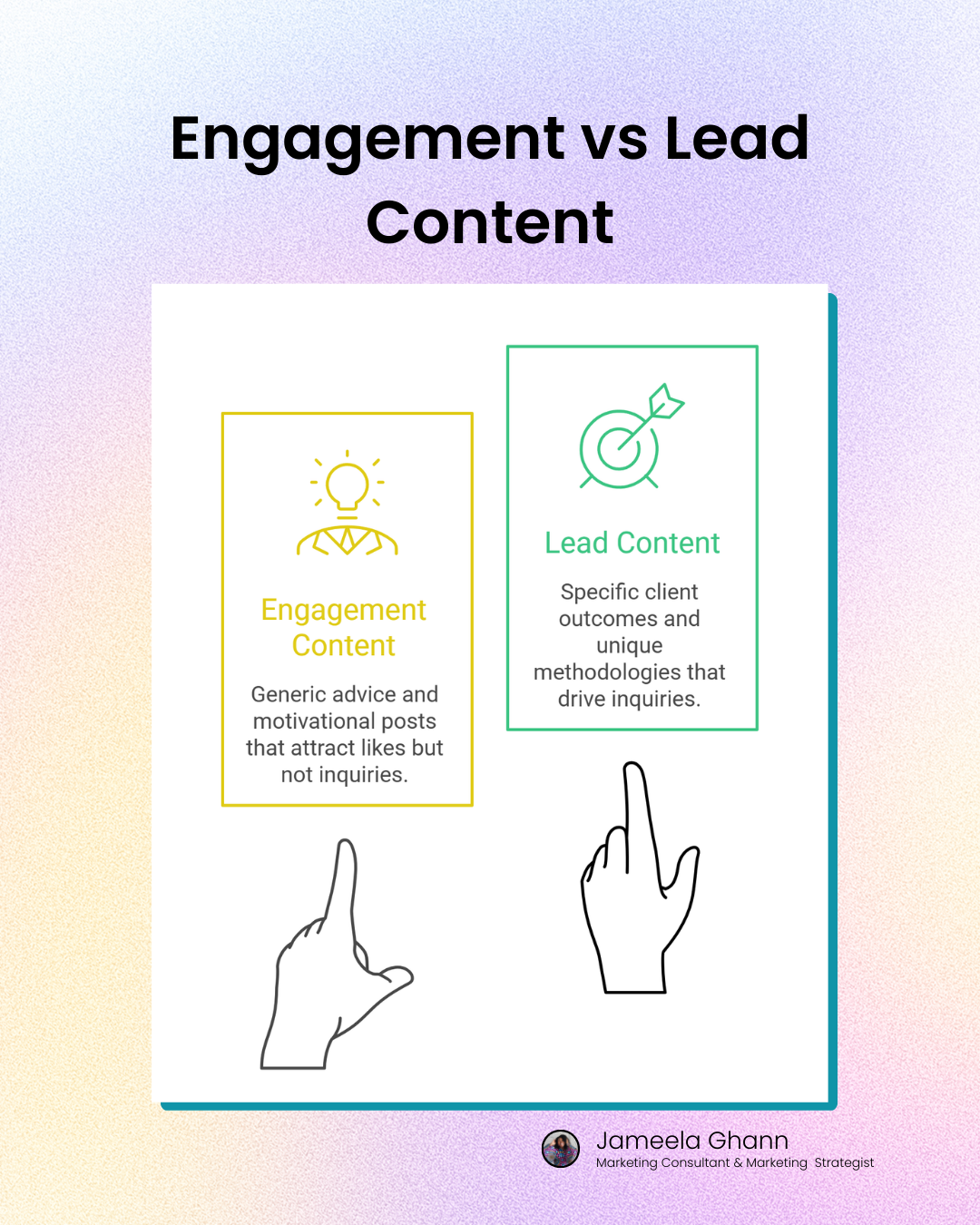
Engagement content gets likes. Lead content gets calls booked.
Here's the breakdown:
Engagement content:
Generic business advice
Motivational posts
Industry hot takes
Content that anyone in your space could write
Lead content:
Specific client outcomes
Your unique methodology
Case studies with real numbers
Content only you could write based on your experience
Sarah's supply chain post was engagement content. Anyone could have written it. Her competitor's case study? That was lead content. Only they could share that specific client story.
Why do B2B companies get likes but no inquiries from LinkedIn posts?
The problem is that most B2B owners think LinkedIn success means getting noticed by everyone.
But you don't want everyone's attention.
You want the right person's attention at the moment they're ready to hire someone like you.
When you post generic advice, you get generic engagement from people who aren't buyers. When you post specific client stories and frameworks, you get inquiries from people who recognize their own problems in your stories.
Stop trying to be relatable to everyone. Start being invaluable to someone.
Remember, likes don't pay bills. Comments don't fill your pipeline.
What Types of LinkedIn Content Actually Drive B2B Leads in 2026?
Now that you understand the difference between engagement content and lead content, you might be wondering which LinkedIn post formats generate the most qualified leads for B2B companies.
After analyzing hundreds of B2B LinkedIn accounts, these formats consistently drive the most booked calls:
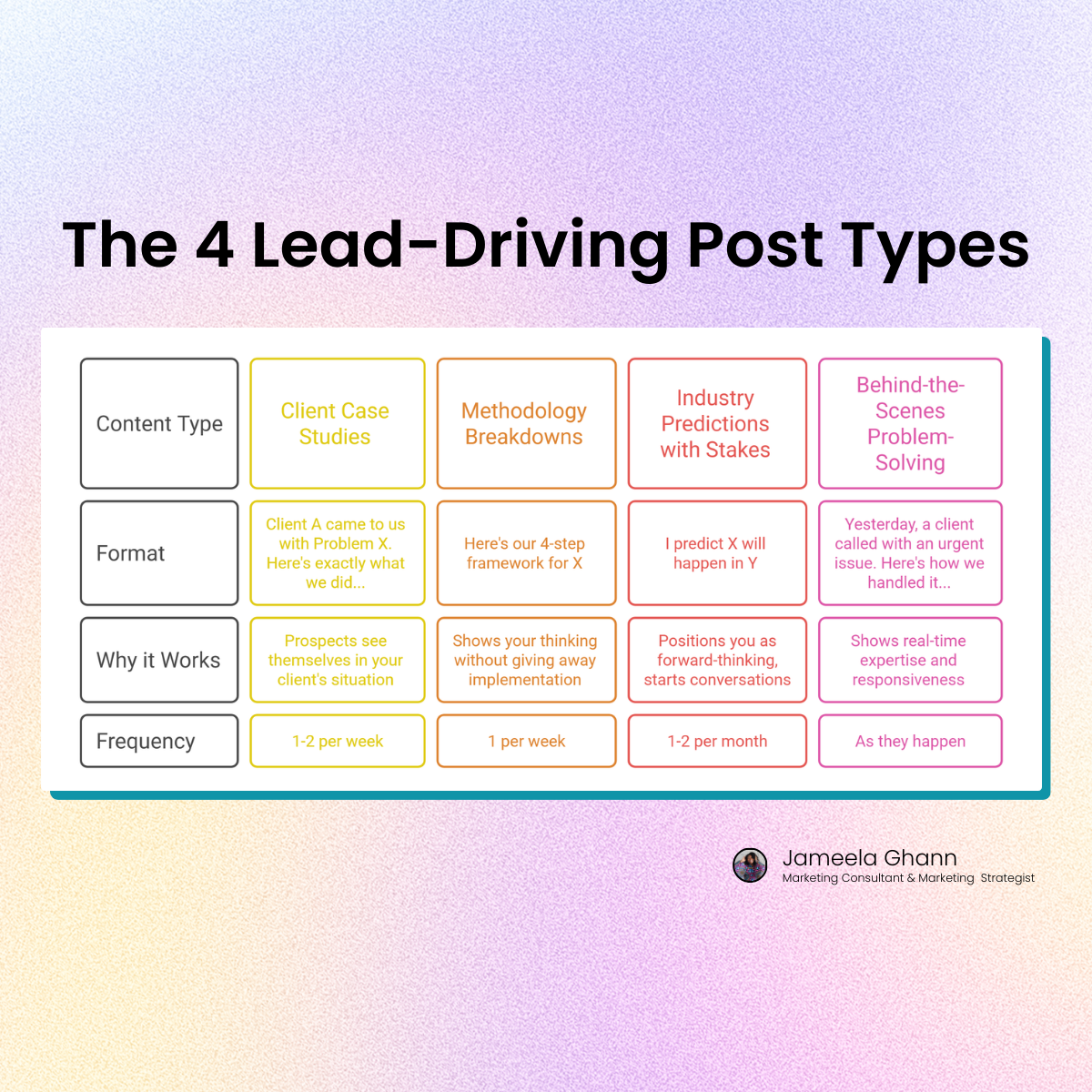
1. Client Case Studies (The Winner)
Format: "Client A came to us with Problem X. Here's exactly what we did..."
Why it works: Prospects see themselves in your client's situation
Frequency: 1-2 per week
2. Methodology Breakdowns
Format: "Here's our 4-step framework for [specific outcome]"
Why it works: Shows your thinking without giving away implementation
Frequency: 1 per week
3. Industry Predictions with Stakes
Format: "I predict X will happen in [industry] within 6 months. Here's why..."
Why it works: Positions you as forward-thinking, starts conversations
Frequency: 1-2 per month
4. Behind-the-Scenes Problem-Solving
Format: "Yesterday, a client called with an urgent issue. Here's how we handled it..."
Why it works: Shows real-time expertise and responsiveness
Frequency: As they happen
How do LinkedIn carousels help professional services firms generate more discovery calls?
Carousels are LinkedIn's secret weapon for professional services.
Here's why they work:
Visual Authority
A well-designed carousel immediately signals that you're serious about your business presentation.
Storytelling Structure
Each slide moves the reader through your process, building trust slide by slide.
Higher Engagement
LinkedIn's algorithm favors carousels because people spend more time viewing them.
Easy Sharing
Decision-makers can easily share your carousel with their team.
Best carousel formats for B2B lead generation:
Before/after client transformations
Step-by-step process breakdowns
Common mistakes (and how you fix them)
Industry benchmarks and comparison
What role do video posts play in B2B LinkedIn lead generation?
Video posts build trust faster than any other content format. When someone can see you explaining a concept, they feel like they already know you before the first call.
But here's the thing: your video doesn't need to be perfect. It needs to be useful.
The best B2B videos on LinkedIn are:
60-90 seconds long
Shot on a phone with decent lighting
Focused on one specific insight
Ended with a clear next step
Mike, a fractional CFO in Vancouver, posts one video per week. Just him talking through a financial concept for 90 seconds. No fancy editing. He books 2-3 calls per month directly from those videos.
The key? He always ends with: "If this is something your business is dealing with, send me a DM and let's chat."
How to Write LinkedIn Posts That Convert Followers Into Booked Calls
Your hook is everything. If the first line doesn't grab them, they're gone.
Here are the hook formulas that work:
The Specific Stat: "73% of our manufacturing clients make the same inventory forecasting mistake."
The Counterintuitive Truth: "Most HR leaders think exit interviews prevent turnover. They actually make it worse."
The Urgent Timeline: "If you're planning a software migration in Q2, you need to start these conversations now."
The Expensive Mistake: "This contract oversight cost our client $40,000. Here's how to avoid it."
Notice what all these have in common? They're specific, relevant to a business problem, and promise valuable insight.
What is the ideal LinkedIn post structure for converting readers into leads?
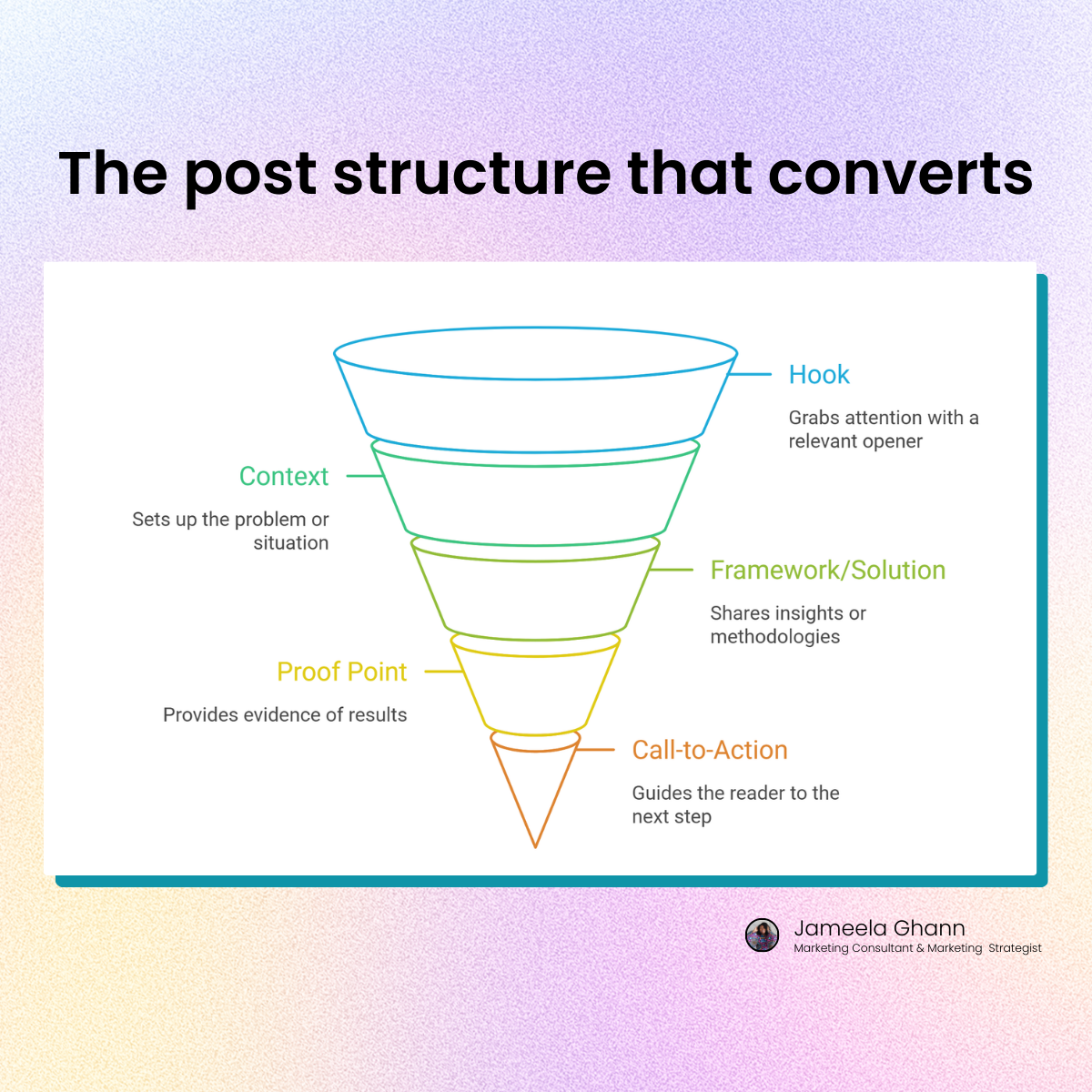
After testing hundreds of posts, here's the structure that books the most calls:
Hook (1-2 lines) Stop the scroll with a specific, relevant opener
Context (2-3 lines) Set up the situation or problem
Framework/Solution (4-8 lines) Share your insight, process, or methodology
Proof Point (1-2 lines) Quick result or outcome
Call-to-Action (1-2 lines) Clear next step for interested prospect
Example:
73% of our manufacturing clients make the same inventory forecasting mistake.
They're using last year's demand patterns to predict this year's orders. But the market has shifted.
Here's our 3-step approach to accurate forecasting:
Weight recent data heavier than historical averages
Factor in supply chain disruptions by region
Build scenario models for best/worst case demand
Our latest client reduced inventory costs by 22% in six months using this method.
If forecasting is keeping you up at night, let's chat. DM me "FORECAST" and I'll send you our diagnostic tool.
What CTA should I use at the end of a LinkedIn post to get people to book a call?
The best CTAs are specific and low-commitment. Avoid "Book a call now!" Instead, try:
For diagnostic conversations: "DM me 'AUDIT' and I'll send you our 10-point assessment."
For educational resources: "Comment 'TEMPLATE' and I'll share our planning framework."
For direct outreach: "If this sounds familiar, send me a message. Happy to share what worked for similar companies."
For calendar booking: "Dealing with this issue? Grab 15 minutes on my calendar: [link]"
The key is matching your CTA to where the prospect is in their buying journey. Early-stage prospects want resources. Late-stage prospects want conversations.
How to Optimize Your LinkedIn Profile to Support Lead Generation
What should a B2B founder's LinkedIn profile headline say to attract clients?
Your headline isn't about your job title. It's about the outcome you deliver.
Here are some weak headlines:
CEO at ABC Consulting
Marketing Expert
Business Strategy Consultant
Here are some Strong headlines:
I help manufacturers reduce inventory costs by 20%+ without disrupting operations
Fractional CFO | Guiding $1M-$10M companies through profitable growth
HR Consultant | Reducing employee turnover for mid-market tech companies
Notice the pattern? Problem + outcome + target market.
How do I write a LinkedIn About section that generates inbound leads?
Your About section should read like a conversation, not a resume.
Here's the framework:
Paragraph 1: The Problem You Solve Start with the pain point your ideal client faces
Paragraph 2: Your Approach How you solve it differently than others
Paragraph 3: Proof Results you've delivered for similar clients
Paragraph 4: The Invitation Clear next step for interested prospects
Example opening:
Most growing companies hit the same wall around $2M in revenue: their financial systems can't keep up.
Cash flow becomes unpredictable. Reporting takes weeks instead of days. The owner is still approving every expense.
I help companies break through that wall...
Keep it conversational. Use "you" and "your" instead of "my clients" and "companies I work with."
How Often Should B2B Companies Post on LinkedIn to See Lead Generation Results?
After tracking dozens of B2B companies, here's the optimal LinkedIn posting frequency for B2B lead generation:
4 posts per week is the sweet spot:
1 long-form thought leadership post (Monday or Tuesday)
2 quick insights or tips (Wednesday, Thursday)
1 social proof post - client story, testimonial, or case study (Friday)
Why this frequency works:
You stay visible without overwhelming your audience
You have time to engage with comments meaningfully
You can maintain quality without burning out
What doesn't work:
Posting daily just to post (algorithm can sense low effort)
Posting less than twice per week (you disappear)
Batch posting without engaging (LinkedIn punishes this)
Does posting more frequently on LinkedIn always mean more leads?
No. More content doesn't equal more leads, but typically, higher quality posts mean more leads.
Lisa, a management consultant in Chicago, posted twice daily for three months. She got lots of engagement but zero calls booked.
Then she cut back to four high-quality posts per week and spent 30 minutes daily engaging with comments and DMs.
Result? Three discovery calls booked in the first month.
The difference? Quality over quantity. Engagement over broadcasting.
Your posts are conversation starters, not billboards. Treat them that way.
How to Build a LinkedIn Content Funnel That Books Calls on Autopilot
A LinkedIn content funnel moves prospects from "never heard of you" to "ready to have a conversation" through strategic content.
Stage 1: Awareness Broad industry insights that establish credibility
Stage 2: Interest Methodology posts that show your unique approach
Stage 3: Consideration Case studies and client stories that build trust
Stage 4: Decision Direct invitations to connect or book calls
Most B2B owners skip straight to Stage 4. That's why their calls to action fall flat.
How do I move a LinkedIn follower from awareness to a booked discovery call in 30 days?
Here's the exact sequence that works:
Week 1: Establish Credibility
Post industry insight with your perspective
Share a contrarian viewpoint with reasoning
Comment thoughtfully on 10 prospects' posts daily
Week 2: Show Your Method
Post your framework or methodology
Share a "mistake I see companies making" post
Continue engaging with target prospects
Week 3: Prove Your Results
Share client case study with specific outcomes
Post client testimonial or success story
Start strategic DM conversations with engaged prospects
Week 4: Make the Ask
Post about working with new clients
Send personalized DMs to warm prospects
Include calendar link in profile for easy booking
The key is sequencing. Each week builds on the last.
How do I use LinkedIn DMs strategically without being spammy or pushy?
The best LinkedIn DMs feel like continuing a conversation, not starting a sales pitch.
Here's what works:
The Comment Follow-Up
Someone engages with your post → DM them about their comment
"Thanks for sharing your experience with supply chain issues on my post. Sounds like you're dealing with some of the same challenges I'm seeing across the industry. Mind if I ask what approach you're taking?"
The Value-First Message
Reference something from their profile → offer something useful
"Saw you just expanded into the US market - congrats! I just helped another Toronto company navigate that expansion. If you're interested, I can share the 3 biggest surprises they encountered."
The Soft Introduction
After they've engaged with several posts → gentle conversation starter
"I've noticed you commenting on a few of my posts about operational efficiency. Are you working on streamlining processes at [Company]?"
What doesn't work:
Immediate connection requests with a sales pitch
Copy-paste messages about your services
"Quick call?" without context
Remember: the goal of the first DM is the second DM, not a sale.
The Bottom Line: LinkedIn Is a Long Game That Pays Off Fast When You Play It Right
Sarah's story doesn't have to end with all likes and no calls.
The shift she needs isn't more content, a bigger audience, or a better posting schedule. It's a clearer understanding of who she's talking to, what they need to hear, and what she wants them to do next.
Your ideal client is already on LinkedIn. They're already scrolling past generic advice, motivational quotes, and industry hot takes. What they're looking for is someone who understands their specific problem and has a credible path to solving it.
That's your opening.
Start with one case study. Write one post that only you could write. End it with one clear, low-commitment ask. Then do it again next week.
Lead generation on LinkedIn isn't about going viral. It's about the right person reading your post on the right day and thinking: "This person gets it. I should reach out."
Build your content around that moment, and your phone will start ringing!

