
You Worked Hard to Get That Booked Call. Here's Why It Isn't Closing.
I worked with a consulting firm in Atlanta whose marketing operator (who was actually the internal comms person) had done everything right.
She'd built a solid LinkedIn presence, set up an application-first funnel, and was consistently booking four to six qualified calls a month.
By every content and lead generation metric, the system was working.
But the calls weren't converting at a high enough rate.
Prospects would show up, have a good conversation, and then go quiet. Everyone was quietly wondering whether the marketing was actually working or whether it just looked like it was working.
When I dug into it, the content wasn't the issue. The leads were qualified!
What was broken was everything that happened after the prospect clicked "book a call." The owner was jumping on calls without reviewing the application first. Follow-up was inconsistent. Nobody had a clear answer to what happened after the call ended, and neither did the prospect.
The marketing had done its job. The sales process hadn't caught up.
When booked calls don't close, marketing usually gets blamed first
This is when
Content gets second-guessed
Application questions get rewritten
Someone suggests trying a different platform.
But in a lot of cases, the content was fine. The leads were qualified. What broke down was the transition from "interested enough to apply" to "ready to become a client."
For boutique professional service firms, that transition requires a specific kind of clarity and care that most small firms never formally build. It's the moment your whole marketing system either pays off or dies on the vine.
The 5 questions that should shape every consult call
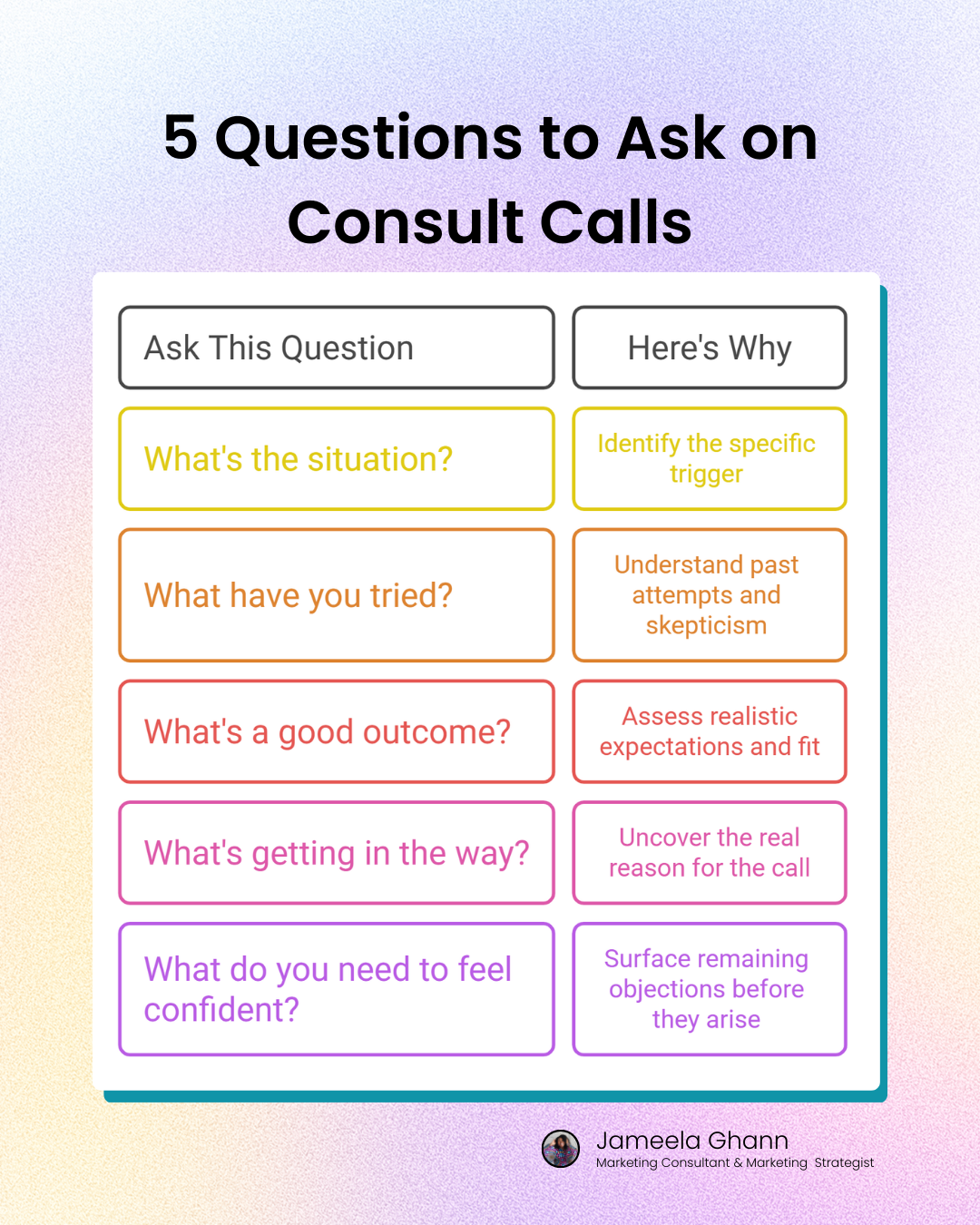
A consult call for a boutique professional service firm isn't a discovery call in the traditional sales sense.
Your prospect isn't just deciding whether they like your offer. They're deciding whether they trust you with something important, often something they haven't fully trusted anyone with before.
These five questions give the call a clear structure and help the prospect feel oriented rather than sold to.
1. What's the situation that brought you here right now?
You want the specific trigger, not the general context. "We've had three key referral sources retire in the past year and our pipeline has been unpredictable ever since" is useful. "We want to grow" isn't.
2. What have you already tried?
This tells you what they've ruled out, what they're skeptical about, and how sophisticated their thinking is about the problem.
3. What would a good outcome look like six months from now?
This is where you find out if their expectations are realistic and whether your program is actually the right fit.
4. What's getting in the way of moving forward on your own?
The answer to this question is usually the real reason they're on the call. It's also the clearest indicator of whether they're ready to invest in a solution right now.
5. What would you need to feel confident about moving forward?
This surfaces the remaining objections before they become a reason to go quiet after the call. When someone tells you what they need, you can address it directly in the proposal rather than guessing at why they went silent.
These aren't a script per se. They're a framework for a conversation that helps both sides figure out whether this is a genuine fit.
The owner-sponsor model and why it matters for closing
One of the things that consistently slows down conversions at boutique firms is unclear decision-making authority.
The operator has the call, or an associate does, but the owner is the one who needs to say yes. And if the owner hasn't been part of the process at all, the decision gets delayed. Sometimes indefinitely.
Inside the Beyond Referrals LinkedIn Engine, we build what I call an owner-sponsor model. The owner doesn't need to be on every call, but they need to be looped in at two specific points.
Before the call: ten minutes reviewing the application so they know who's coming in and what the conversation is likely to cover.
Within 24 hours after: a clear yes, no, or "here's what I'd need to move forward."
Two touchpoints. No more waiting. Conversion timelines shorten, and the prospect feels the weight of the whole firm behind the conversation, not just one person acting on behalf of it.
The follow-up structure
Most boutique firms have some version of "we'll follow up," which in practice means one email three days later and then nothing.
Here's the four-touchpoint sequence I use with firms in the program.
Same day, within two hours
Send a short email recapping what you heard from them, what you'd recommend, and what the next step is. Not a proposal yet. Just a clear, specific summary that shows you were listening.
Within 48 hours
Send the proposal or scope document if the call went well. Waiting longer lets the momentum cool off.
Day five, if there's no response
A one-sentence check-in. Something like: "Wanted to make sure the proposal reached you and answer any questions that came up."
Day ten
A final follow-up that either moves things forward or closes the loop gracefully. Something like: "I want to be respectful of your time. If now isn't the right moment, just let me know and we can reconnect when the timing makes more sense."
"We're not salesy. That's not how we work."
I hear this a lot from boutique firm owners, and I understand what's behind it.
They've built their practice on relationships and trust. The last thing they want is to feel like they're running a high-pressure sales operation.
Here's what I've seen in practice: a clear, well-structured follow-up process actually reinforces trust rather than eroding it.
When a prospect hears from you promptly, gets a summary of what you discussed, receives a proposal that speaks directly to their situation, and knows exactly what the next step is, they feel more confident about working with you.
Going quiet after a call or being vague about next steps is what makes prospects nervous. Clarity is what moves people forward.
That's why I built the Beyond Referrals LinkedIn Engine
Getting booked calls is only half the system. Converting them is the other half, and it deserves the same attention.
The LinkedIn Engine covers the full picture in eight weeks, including:
The five-question consult call framework adapted to your firm's specific offer
An owner sponsor model so decision-making authority is always clear before and after the call
A four-touchpoint follow-up sequence built into your workflow so it doesn't fall through the cracks
Weekly review sessions with me, Jameela, covering what's converting and what to adjust
Templates your operator can use immediately
Key Takeaways
When booked calls don't convert, the handoff process is often where things break down, not the marketing
A consult call at a boutique service firm is a two-way fit conversation, not a traditional sales pitch
The owner sponsor model shortens conversion timelines by keeping decision-making clear and engaged at two specific points
A four-touchpoint follow-up sequence closes more deals than sporadic check-ins
The Beyond Referrals LinkedIn Engine builds the full system from booked call to closed client in eight weeks
Two ways to move forward:
Apply to the Beyond Referrals LinkedIn Engine For boutique professional service firms in the US and Canada who want a complete lead system that doesn't just book calls, it converts them.
Take the Beyond Referrals Scorecard A free five-minute diagnostic to find where your LinkedIn-to-call system is breaking down. Take this first if you're not sure where to start.

